

What to Do Immediately After Water Damage in Your San Diego Home
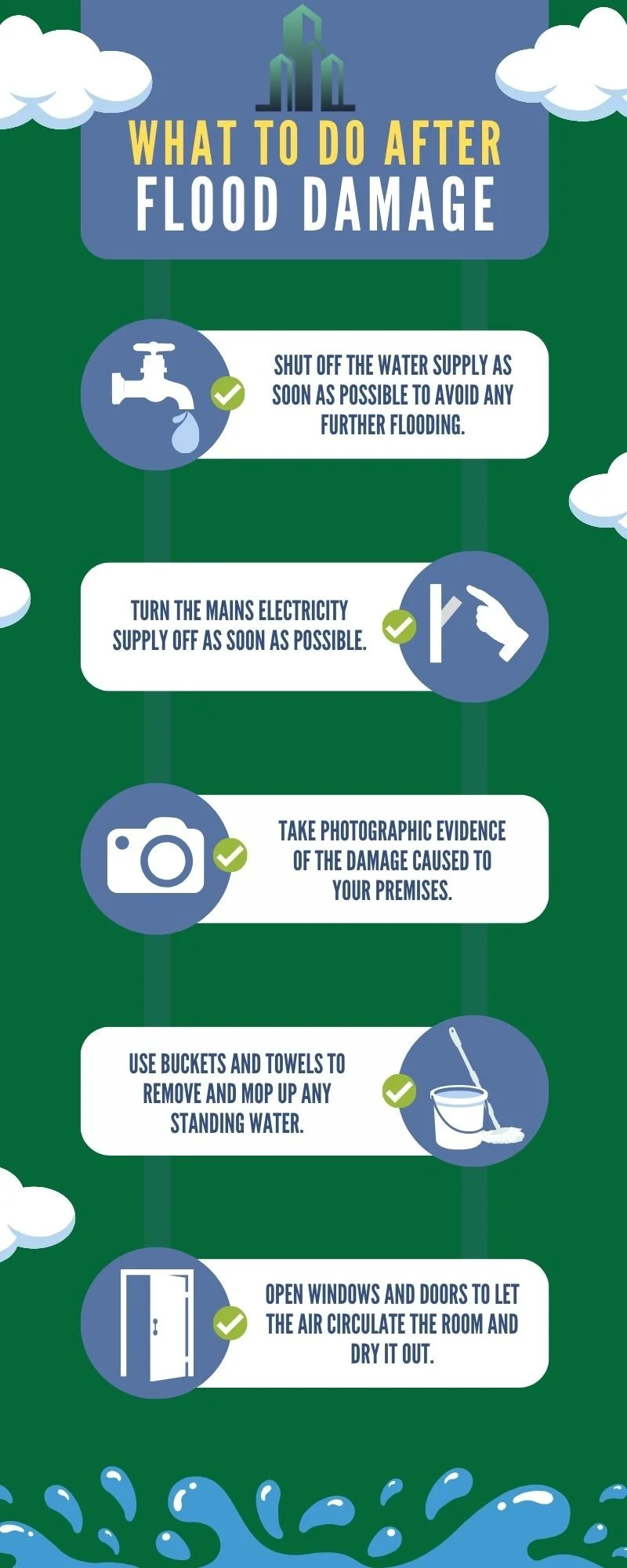
Infographic illustrating steps to take after flood damage, including shutting off the water supply, turning off electricity, taking photographic evidence, mopping up standing water with buckets and towels, and opening windows for ventilation. Designed for San Diego homeowners dealing with water restoration needs.
When water damage strikes your San Diego home, the decisions you make in the first 30 to 60 minutes determine how much damage you end up with, how much your restoration costs, and whether your insurance claim gets paid. This guide walks you through every step — from the moment you discover water to the point where a professional team takes over.
If you have an active emergency right now: Call Fadox Construction at (619) 880-6554. We respond 24/7 across all of San Diego County with an average response time under 2 hours.
Why the First Hour After Water Damage Is Critical
Water doesn't sit still. From the moment it contacts your walls, subfloor, insulation, and framing, it begins migrating — wicking upward through drywall, spreading laterally under flooring, and seeping into cavities where it becomes invisible. The longer it sits, the deeper it penetrates, and the more material has to be removed rather than dried.
According to EPA mold guidelines, mold can begin growing within 24 to 48 hours of water exposure. San Diego's coastal humidity — especially in summer — accelerates that timeline significantly. Mold that begins in a wall cavity after a slow leak can spread to an area requiring professional remediation before you even notice it.
The cost difference between acting in the first hour versus waiting 24 hours is real and significant. Restoration companies consistently report that water damage discovered and addressed within the first few hours results in shorter drying timelines, less material removal, and substantially lower total restoration costs. Every hour of delay narrows your options and deepens the damage.
Step 1 — Identify and Stop the Source of Water
Before anything else, locate and stop the water. An ongoing leak or flow makes everything else pointless.
For a burst pipe or supply line failure:
Locate your main water shutoff valve. In most San Diego homes, this is at the street near the water meter, or on the exterior wall near where the main line enters the house. Turn it fully clockwise to close. If you cannot find or operate the main shutoff, call your water utility — San Diego's emergency line for water service issues is available 24 hours.
For an appliance failure (dishwasher, washing machine, refrigerator):
Turn off the individual supply valve behind the appliance. These are typically quarter-turn ball valves. If the valve is stuck or inaccessible, shut off the main.
For a roof leak or exterior water intrusion:
You cannot stop rain, but you can limit entry. Move belongings away from the affected area and place buckets to catch dripping water. Do not attempt to access your roof during rain or if there is any risk of slipping.
For sewage backup:
Stop using all plumbing fixtures immediately — every flush, every drain, every running faucet adds volume to a backed-up system. Do not attempt to clean up sewage yourself. Sewage water is Category 3 — a biohazard — and requires specialized protective equipment and disposal protocols. Call (619) 880-6554 immediately.
Step 2 — Assess Electrical Safety Before Entering
Water and electricity are a lethal combination. Before walking into a flooded room, assess the electrical situation.
If water is near electrical outlets, baseboard heaters, or any plugged-in appliance — do not enter until you have confirmed power is off to that area. Go to your electrical panel and turn off the breakers for the affected rooms. If your panel is in the flooded area and you cannot safely access it, call SDG&E's emergency line to disconnect power at the meter: (800) 411-7343.
Do not use extension cords, power tools, or any electrical devices in wet areas. Do not use a standard vacuum to remove water — use only a wet-dry shop vacuum specifically rated for liquid pickup. If water has reached the electrical panel, HVAC system, or any major appliances — call a licensed electrician before doing anything else in that space.
Step 3 — Document Everything Before You Touch It
Your insurance claim depends on thorough documentation. Insurance adjusters look for evidence of the damage at its worst — before cleanup began. If you start removing water and damaged materials before documenting, you may have no proof of the original scope.
What to document:
- Photograph and video every affected area from multiple angles
- Capture the water source, the spread of water across floors and walls, visible saturation lines on drywall, and damaged belongings
- Document the source explicitly — if a pipe burst under a sink, photograph the failed fitting
- Note the time and date — your phone's camera embeds this metadata automatically
- Gather any receipts, photos, or documentation for valuable damaged items — furniture, electronics, flooring
- Keep a written log: when you discovered the water, what time you shut it off, what actions you took, and who you called
Insurers reconstruct timelines during claims review. Contemporaneous notes and time-stamped photos carry significant weight in disputed claims.
Step 4 — Call Your Restoration Contractor, Then Your Insurance Company
Call your restoration contractor first. Your insurance company will ask how you are mitigating ongoing damage. Having a licensed restoration contractor en route demonstrates that you responded appropriately. It also means your contractor can begin documenting damage professionally before it changes — which strengthens your claim.
Call Fadox Construction at (619) 880-6554. We respond 24/7, document everything for your insurance file from the moment we arrive, and coordinate directly with your adjuster. You do not need to manage insurer communication yourself.
Then call your insurance company. Inform them of the loss, describe the source and scope, and let them know a restoration contractor is already on site or en route. Most major carriers have 24/7 claims lines. Get a claim number and the name of whoever you spoke with.
Coverage note: Most standard homeowner's policies cover sudden and accidental water damage — a burst pipe, appliance failure, accidental overflow. They generally do not cover gradual leaks or flooding from outside the home. Your contractor can help you interpret your policy language during the assessment.
Step 5 — Begin Safe Water Removal If You Can Do So Without Risk
If the water source is controlled, electrical safety is confirmed, and the water is clean (Category 1 — from a supply line), you can begin removing standing water while waiting for the restoration crew.
What you can safely do:
- Use a wet-dry shop vacuum to remove standing water from hard floors
- Mop up remaining water with old towels or mops
- Remove small rugs and take them outside to dry
- Place aluminum foil or blocks under furniture legs to prevent rust and tannin stains from transferring to wet carpet
- Open interior doors to increase air circulation between rooms
What you should not do:
- Do not use household fans or box fans to try to dry the space. This is one of the most common mistakes homeowners make. Household fans move air but do not remove humidity — they distribute moisture-laden air through unaffected parts of the house and can spread mold spores to areas that were previously clean
- Do not remove wet drywall or flooring yourself. Saturated drywall may contain hidden moisture pockets, and improper removal can spread contamination or damage structural elements
- Do not attempt to dry carpet by lifting it yourself without professional guidance. Carpet retains water in its backing and pad layers that surface drying does not reach
Step 6 — Protect Salvageable Belongings
Move dry or lightly affected belongings to a safe, dry area before the restoration crew arrives. Prioritize:
- Electronics — move immediately to a dry location and do not power on until assessed for moisture. Water inside electronics causes corrosion that may not appear immediately but causes failure later
- Documents and photos — place in sealed bags or move to a dry room. Wet paper deteriorates quickly
- Furniture — move to a dry room if possible. For heavy pieces that cannot be moved, place aluminum foil under legs. Solid wood furniture can be dried successfully if treated within the first 24 to 48 hours
- Clothing and fabric items — remove from wet areas and place in a dry location. Do not launder immediately if mold is suspected — get professional assessment first
- Heavily saturated items — particleboard furniture, ceiling tiles, unsealed drywall — are typically not salvageable once fully wet. Your contractor will advise on what can and cannot be restored
Water Damage Categories — What Type of Water Are You Dealing With?
Not all water damage is equal. The category of water determines the safety protocols, the cleaning methods required, and what materials can be salvaged versus removed.
| Category | Source | Safety Level | Material Impact | Typical Cost Range |
|---|---|---|---|---|
| Category 1 — Clean Water | Supply lines, water heater, rain water not yet contaminated | Safe to contact without PPE | Most materials can be dried in place if addressed within 24–48 hours | $1,500 – $7,000 |
| Category 2 — Gray Water | Washing machine overflow, dishwasher discharge, toilet overflow without solids | Contains bacteria — wear gloves, avoid face contact | Porous materials require professional cleaning or removal | $3,500 – $12,000 |
| Category 3 — Black Water | Sewage backup, outdoor flooding, standing water over 48 hours | Biohazard — full PPE required, professional disposal only | All porous materials (drywall, insulation, carpet) must be removed | $7,000 – $25,000+ |
Category determines cost. Water damage addressed within the first few hours is significantly less expensive to restore than damage left to migrate and become contaminated. Every hour of delay can move damage from one category boundary to the next.
What Happens When the Fadox Team Arrives
When Fadox technicians respond to a water damage emergency in San Diego, here is exactly what the process looks like from the moment they walk in:
- Assessment and documentation — Technicians use moisture meters and thermal imaging cameras to map the full extent of water migration, including areas invisible to the naked eye. Everything is documented for your insurance file simultaneously
- Water extraction — Industrial-grade truck-mounted and portable extraction units remove standing water far more completely than any consumer equipment
- Structural drying setup — Commercial air movers and refrigerant dehumidifiers create the specific airflow and low-humidity environment required to dry walls, subfloors, and cavities to IICRC-standard moisture levels
- Daily moisture monitoring — Readings are taken, documented, and logged. Drying is not declared complete until all affected materials reach target moisture content — typically 3 to 7 days
- Mold prevention treatment — EPA-registered antimicrobial treatments applied to affected areas during and after the drying phase
- Repairs and reconstruction — Drywall, flooring, painting, and structural repairs handled by our licensed general contracting team under CA License #1059186
- Final inspection and sign-off — Moisture verification confirms full dryness before project close. Complete documentation provided for insurance and property records
See before-and-after results in our project portfolio or learn more about our full water damage restoration services in San Diego.
Common Mistakes San Diego Homeowners Make After Water Damage
- Waiting to call a professional. The most costly mistake. Every hour of delay increases material saturation, mold risk, and total restoration cost. If you are uncertain whether damage is serious enough to call, call anyway — a professional assessment is always preferable to discovering hidden damage later
- Using household fans to dry. This distributes moisture without removing it and can spread contamination to unaffected areas. Professional drying uses commercial dehumidifiers that extract moisture from the air entirely
- Removing wet drywall or flooring without professional guidance. Hidden moisture pockets, contamination risk, and structural considerations make DIY demolition a liability
- Not documenting before cleanup. Insurance claims require evidence of original damage scope. Once cleanup has begun, the evidence is gone
- Calling the insurance company before a contractor. Your insurer's interest is in minimizing the claim. Get a contractor on site first so the full scope is professionally documented before the adjuster's assessment
- Assuming gray or black water can be cleaned rather than removed. Contamination in porous materials cannot be cleaned to a safe standard. Professional assessment determines what stays and what goes
Frequently Asked Questions — Water Damage in San Diego
How quickly does mold grow after water damage in San Diego?
EPA guidelines indicate mold can begin growing within 24 to 48 hours of water exposure. San Diego's coastal humidity makes this timeline potentially shorter, particularly in summer months. Mold typically begins in concealed spaces — inside wall cavities, beneath flooring, behind baseboards — where it can develop significantly before becoming visible. This is why professional moisture detection after water damage is essential, not optional.
Does homeowner's insurance cover water damage in San Diego?
Most standard homeowner's insurance policies cover sudden and accidental water damage — a burst pipe, appliance failure, or accidental overflow. They typically do not cover gradual leaks, flooding from exterior sources, or sewer backup without a specific rider. Fadox works directly with all major insurance carriers and handles documentation and adjuster communication on your behalf. The critical factor for claim approval is demonstrating you responded promptly — which professional documentation and rapid response directly supports.
Can I dry my home myself after water damage?
Consumer equipment — household fans, shop vacuums, residential dehumidifiers — cannot match the capacity or effectiveness of commercial drying equipment. More importantly, consumer drying cannot locate or address hidden moisture in wall cavities, subfloors, and insulation. Professional moisture meters and thermal imaging cameras identify saturation in areas that look dry to the eye. Incomplete drying leads to mold growth in concealed spaces that may not surface for weeks — resulting in a secondary remediation project that costs significantly more than the original restoration would have. Contact Fadox for a same-day assessment.
What is IICRC certification and why does it matter?
The IICRC (Institute of Inspection, Cleaning and Restoration Certification) is the leading standards body for the restoration industry. IICRC-certified technicians are trained in water extraction science, psychrometrics (the physics of drying), and mold prevention protocols. Insurance adjusters and property assessors expect IICRC-standard documentation and methods — work performed by non-certified contractors may be disputed by your insurer. Every Fadox technician is IICRC certified.
How much does water damage restoration cost in San Diego?
Costs vary significantly by damage category, affected square footage, and materials involved. Category 1 clean water affecting a single room typically runs $1,500 to $3,500. Category 2 gray water events affecting multiple rooms run $3,500 to $12,000. Category 3 black water or large-area flooding events can exceed $25,000. Reconstruction costs add to the base restoration figure depending on the scope of material removal required. Fadox provides free written estimates before any work begins — call (619) 880-6554.
How long does water damage restoration take in San Diego?
The drying phase takes 3 to 7 days in most cases using commercial equipment. Rushing this phase risks incomplete drying and future mold. After the structure reaches target moisture levels, reconstruction begins — typically 1 to 4 weeks depending on the scope of repairs needed. Fadox provides a project timeline estimate at the initial assessment so you know what to expect before work begins.
What areas of San Diego does Fadox serve for water damage emergencies?
Fadox responds 24/7 across all of San Diego County — Downtown, La Jolla, Pacific Beach, North Park, Hillcrest, Chula Vista, El Cajon, Santee, Rancho Bernardo, Carlsbad, Escondido, La Mesa, Lakeside, Spring Valley, and all surrounding communities. Average response time is under 2 hours from our base at 702 Broadway, Downtown San Diego. See our full San Diego County service areas page.
Should I call my insurance company or a contractor first?
Call your restoration contractor first. Your insurance company will ask how you mitigated ongoing damage — having a licensed contractor on site or en route demonstrates appropriate response. It also means the full damage scope is professionally documented before the adjuster's assessment, which protects your claim. Call Fadox at (619) 880-6554 first, then call your insurer with the claim while our team is en route.
Neighborhoods We Serve Across San Diego County
Fadox responds to water damage emergencies 24/7 across all of San Diego County — average response time under 2 hours from our base at 702 Broadway, Downtown San Diego. See our full service areas page.
- Downtown San Diego and Gaslamp — high-rise plumbing systems and aging building infrastructure
- La Jolla — coastal corrosion and luxury property restoration
- Pacific Beach — dense rental stock with deferred maintenance and high appliance failure rates
- North Park and Hillcrest — aging galvanized plumbing in 1920s–1950s housing stock
- Chula Vista — storm drainage issues and newer construction plumbing defects
- El Cajon — temperature-driven pipe stress and seasonal storm flooding
- Santee — older suburban housing with end-of-life plumbing systems
- Rancho Bernardo — complex plumbing in large single-family homes
- Carlsbad and North County — coastal corrosion and HOA-managed property response
- Escondido and East County — seasonal flooding and rural property response
Call Fadox Construction for 24/7 Water Damage Emergency Response in San Diego
Water damage does not wait. The decisions made in the first hour determine the outcome — the extent of damage, the total cost, and whether your insurance claim is paid in full.
- Available 24/7, 365 days a year — including holidays, nights, and weekends
- Average response time under 2 hours across all San Diego County
- Free written estimate before any work begins
- All insurance carriers accepted — we handle documentation and adjuster communication
- IICRC certified technicians on every job
- CA License #1059186 · Fully Bonded & Insured · 1-Year Workmanship Warranty
Call now: (619) 880-6554
Non-emergency inquiries: fadoxconstruction.com/contact
Full water damage restoration services: fadoxconstruction.com/water-damage-restoration-san-diego
24/7 emergency services: fadoxconstruction.com/24-7-water-damage-repair-san-diego
Fadox Construction and Restoration · 702 Broadway, San Diego, CA 92101 · CA License #1059186 · (619) 880-6554
